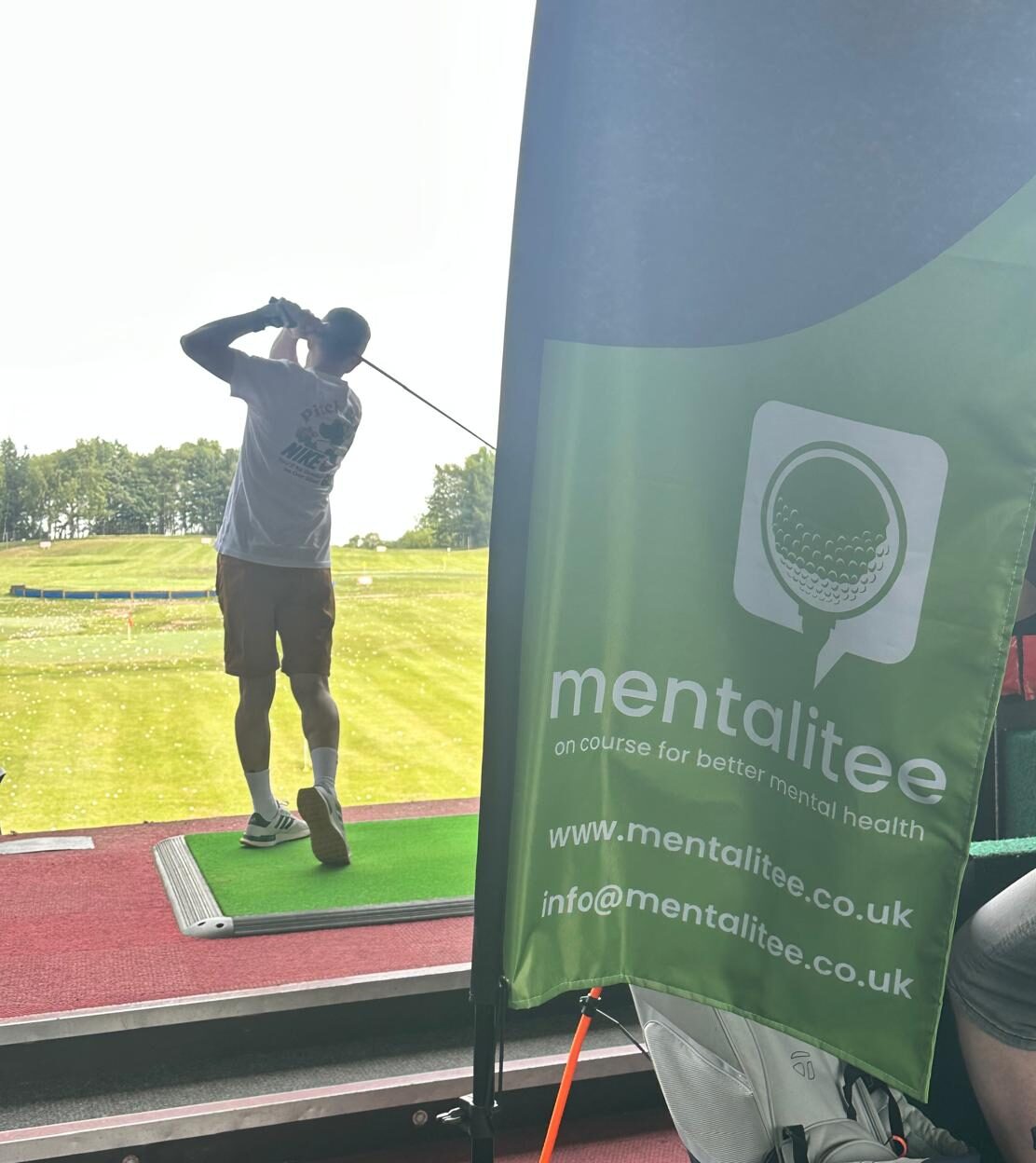
As 2025 drew to a close, Owen Coombes sat down with Matt Cross, Senior PGA Professional at Trafford Golf Centre and mentalitee‘s teaching partner, to discuss his golfing life, the game’s role in helping maintain his mental and physical health, and how he gets students of all ability levels to focus on the journey, not the destination.
We’d planned to post a video of the interview, but the range was so busy not only did we struggle to find a quiet backdrop, the audio was so awful a podcast format went out the window as well. It’s good to slow down and read something though, so here’s the transcript. We promise it’s worth your time…
OC: Thanks so much for taking time out to talk with us. I think a good start point, if you don’t mind, would be offering a little insight into who you are, what a teaching professional does, and where you sit in the golfing landscape overall.
MC: No problem at all. I’m a PGA professional at Trafford Golf Centre in Greater Manchester. I turned pro in 2021, so I’ve been doing this for five or so years now. A PGA pro is almost, I guess, a flag-bearer for golf. I see my role as highlighting all things that are good about the game, and trying to get as many people involved in the sport as possible..
OC: Is it fair to say instruction is at the heart of that?
MC: Correct, day to day.
OC: And you become a qualified pro by completing a course, administered by the PGA, that’s equivalent to a degree, I believe?
MC: Yes, so the PGA administers the qualification, which involves competing – demonstrating you can play golf to a certain level of ability – and academic work, which as you say is a degree course. This covers everything from the fundamentals of instructing clients through to how to build and tailor golf clubs. The day-to-day teaching follows a structured format to cover clients who might be beginners right up to those who are good enough to turn pro themselves. So I work with anyone at any level of ability, and my job is to make sure they get maximum enjoyment out of what they’re doing. And for 99% of golfers that involves getting better – whatever that means for them.
OC: You’ve read my mind there: I was going to touch on that point later, what ‘better’ or ‘good’ actually means in a golfing context. Back to you for now though: what was your initial journey into golf, and was there a specific point along the way when you realised this was maybe your calling?
MC: It started with me. None of my family played.
OC: Really? I’d always assumed you came from a golfing family….
MC: Not at all. My nanna was a care worker, and on a spur-of-the-moment thing decided to take the group of people she cared for to a driving range one day. When she’d been, she said to me I think you’ll enjoy it, you should go and give it a go, and so I did. And though I can’t think now of any one moment particularly clearly, I just recall there being something intrinsic in it that I enjoyed. After probably about a year, my dad got me a lesson, and I remember hitting a shot in that lesson like I’d never hit. That, I can remember like yesterday. Watching the ball fly, the feeling off the club. And really, from there on in, that was it. From about ten years old, that was me set. I just wanted to be on or around the golf course. Now, at that stage I wasn’t thinking about it being a career one day. I just spent every minute of each day thinking about golf. For me the school summer holiday was six weeks of golf every single day.
OC: Scrolling forward a bit, to when you did start thinking about careers: am I right you took a diversion?
MC: Yes, I actually studied music and business at university, so I was definitely off on a non-golfing tangent for a while. I was sort of pushed towards a business-focused course after studying at sixth-form college, even though I was still playing loads of golf at the time. I got a corporate job on the back of my degree and ended up training staff, and found I really enjoyed training people. So I thought, why not take that training aspect that I really enjoy, and explore where that could lead in golf? That’s when I made contact with the PGA and started my qualification. When a job opportunity came up at Trafford Golf Centre, I jumped at it knowing it was a really good hub to be at. And this is where I’ve been since.
OC: You touched on it briefly, but just to circle back as I can’t resist: you really never considered trying to become a Tour pro?
MC: No, I really never did. I mean, when I was a lot younger I did wonder what it would be like, but when I got to that age of 16 to 18 even though I was playing a lot, it wasn’t enough to push through to that level. It was genuinely that year after I finished uni, and went into the world of work, when I figured out how I could maybe make a career out of something I loved, decided I wanted to try, and contacted the PGA. It was the teaching standpoint that sold me on the idea. I do play in the odd professional event nowadays though.
OC: Really?
MC: Yes!
OC: You kept that quiet from me.
MC: (Laughs) It’s maybe seven, eight times a year. And only because I really enjoy it, not as a viable way to make any money.
OC: Yes, I should stress: it’s not the prospect of money that turned my head there. It’s the standard of golf you must be playing to compete in pro tournaments. But the point you made about enjoyment gets right to the heart of mentalitee. There’s so much more to golf than the scorecard. We argue, don’t we, that most of the best parts come to you when you’re not focused on your score.
MC: Absolutely.
OC: So for you to be competing at that elite level, but still be preoccupied mainly with enjoying the experience, is a really powerful insight.
MC: It honestly is all about the enjoyment.
OC: That said, I am going to drag you back briefly to the realm of traditional ‘golfing achievements’. Any you’d be happy to share?
MC: There’s a few, maybe. I’ve got two hole-in-ones.
OC: Nice. Walk us through them.
MC: The first was in Lanzarote, playing with my dad who’s also now a keen golfer. That was really nice. Still my favourite thing to do in golf, play with my dad. The second was at Adlington and it’s a bit contentious, as it’s a par-three course. It was 135 yards, so a proper distance for a hole but the real problem is, it was unwitnessed.
OC: Here we go…
MC: Yep. First thing I did afterwards was tell my dad, but he just said Didn’t happen, did it. No proof. Brought me straight back down to earth!
OC: We know which side he’s on then. (For anyone new to the game, there’s an ongoing debate over whether hole-in-ones in any situation other than an ‘official’ round – one where you’re playing with other people at a registered tee time – actually count.) My only ace was on the way back to the car park after a practice session, by myself. No witness. I’ve been known to defend it quite strongly, and then other times I find myself thinking…maybe not…
MC: To be completely honest mate, neither was a great golf shot. Both were slightly thin on the strike and just kinda rolled up there. Couldn’t see either of them on the green. Then, you know, you’re thinking …Maybe it’s in the hole? And both times, they were.
OC: True what they say: no pictures on a scorecard. Any other achievements of note?
MC: I had the Junior course record at Macclesfield Golf Club. That was when I was either 15 or 16. I shot 68 there, off the white tees. That’s when I proved to myself that I could play a complete game: driving, approach shots, chipping, putting.
OC: Does the record still stand?
MC: Not too sure. I’ve not been told that it doesn’t…but I’ve not tried too hard to find out, in case it has actually been beaten!
OC: Think I’d be the same. Best not to know. Was that your lowest round?
MC: I shot a 65, around Formby Ladies’, and I’ve been six under par around Manchester Golf Club.
OC: I’m going to stop asking in a minute…
MC: The best I’ve ever played was another time at Macclesfield. I was eight under par for the first ten holes, but the back eight were closed so I couldn’t finish. So I’ll never know how low I might have gone.
OC: It does get a bit boggy down there. How frustrating. Pivoting slightly now: you and I have talked at length about most aspects of golf in the time we’ve known each other, and I’d say you’re particularly tuned into the aspects of the game that help your mental health. When did that first present itself to you: is it something that, on reflection, was there from the start, almost unspoken, or is it as you’ve matured, played more and had more golfing experiences, that it has become clear?
MC: Interesting question. My own view of myself is that I’ve always been quite a calm individual. Quite collected by nature. Whereas other family members have struggled at times with their mental health. Now, for a while I credited that calm nature as the reason I was well suited to golf, but at some point I realised the absolute reverse is true: golf was, and is, probably the main reason for my calm nature.
OC: How did that realisation affect you?
MC: I dug into it a bit, and asked myself the question If someone took golf away, what impact would it have on you? And I knew straight away it would be profound. It’s a physical outlet, a period of gentle exercise when at times it can feel like just you amongst nature. It creates the space to properly collect your thoughts. For most of a round you don’t really have to do much apart from exist and be there. Be present. I really like that.
OC: I’ve seen for myself, in a small-group mentalitee session, how you talk up these benefits and signpost participants to positive things they should focus on, from the moment they take up the game, to help support a healthy state of mind. Could you maybe summarise some of those pointers for anyone reading this?
MC: The main thing for me is spotting, and taking, the little wins. Because golf is full of them. The feeling when you hit a really, really good golf shot and prove to yourself that you can do something that on paper is, technically, very tricky. Or, say, the first time you’re out on any form of course, and you’re probably still playing the odd air-shot, and not getting the balls you do manage to hit as far or as straight as you’d like, something as simple as making the right club selection is a big step forward. You’ve learned something about the game in general, and how you play it. On any day playing golf, there will be so many small victories like that which you can celebrate if you let yourself look for them, and accept them. And it’s equally true for established players. It’s far too easy for them to hit a good shot and think, That’s what I expected to do, or even That’s what I shouldbe able to do, instead of letting themselves enjoy the achievement. It’s a challenging game. And that is really important to embrace. Enjoy the hard shots. Never think that you ‘should’ be hitting them well, because they’re not easy.
OC: Couldn’t agree more. Turning to the more practical aspects of the small group sessions mentalitee runs, because you helped set the template being the first instructor to host one. What should people expect to experience, if it’s their first contact with golf?
MC: First and foremost I make it a safe space, not just for getting into golf but on a personal level. There’s no expectation in relation to anything: how, and how much, participants interact with me or others, and certainly not in terms of performance. You truly do not need to know a thing about golf when you turn up at one of these sessions. It just gives you the opportunity to give it a go in whatever way you feel comfortable. Because you know, when you do start trying it, you very quickly realise it’s not the easiest sport! There are lots of parts to consider. But the solution to that is finding one thing to focus on, and that’s the golf ball. And once you do that, it really quietens all departments of the mind. That’s of huge benefit to me in my own life. I feel a sort of tranquil calmness when I have to focus on the ball and nothing else. Aside from that I try to initiate discussions about what golf is and where it can lead somebody. We might talk about how you progress to getting out on a course one day, or we might zoom in on the general benefits we’ve already discussed: gentle exercise, time in a green space.
OC: Can we delve into that previous idea a bit more, about golf being difficult? I’ve had my fair share of people ribbing me when trying to promote golf as a source of calm, I suspect because their reference point for the game is the stereotypical image of a bloke in bad trousers smashing a club into a tree in a rage after hitting a bad shot. Or their own experiences of trying the sport and it not going as well as they maybe expected it to.
MC: It just takes us back to the idea that people need to lean into how challenging golf is. Accept it as a challenge, and be kind to yourself. You’re going to find yourself in scenarios where you hit shots which aren’t necessarily great, but it happens. Learn what you can from it, and move on.
OC: Do people maybe expect golf to be easier than it is because when you see it being played on TV, it looks so effortless? You watch football, or rugby, or something even more extreme, physically, like boxing or UFC and you can see the exertion involved. Golf at the elite level looks easy…
MC: It does, and it’s misleading.
OC: We’ve spoken in the past about the book Zen Golf, by Dr. Joseph Parent, and mentalitee reviewed and recommended it in an early blog post. The blog called out an often-quoted section of Zen Golf called ‘Fire Your Evil Inner Caddie’, the idea behind which is that most golfers wouldn’t tolerate someone else speaking to them in the way they speak to themselves when they make a mistake.
MC: Correct. Another way of putting it is never, ever say anything to yourself that you wouldn’t say to your kids.
OC: I love that.
MC: Always be kind to yourself on a golf course. It’s no different to anywhere else in life, where everyone would agree we need to show ourselves kindness and respect. I think the way you respond to the challenges golf sets for you, can teach real humility. Going back to the Tour pros, if you think about it they lose most of the time. Even when Tiger Woods was at his peak, his win ratio was still around 30%. 70% of the tournaments he entered, he didn’t win.
OC: I hadn’t heard that stat before, and I’m good on my Tiger trivia. Let’s close with the question I said we’d get to: what ‘better’, or ‘good’, mean in a golfing context.
MC: I have a number of clients on my books at the moment who have no aspiration to play on a golf course. Not currently, maybe not ever.
OC: I remember you telling me about this…
MC: Yes, and the number has increased since we discussed it. For them, golf is turning up at the range, practising, hitting a ball, getting it to go a little bit straighter, a little bit further. They’ve got no intention toward getting a handicap, joining a club or society, or anything like that. I can, and do, help people with those things. And I know mentalitee helps steer people in those directions as well, if they want to. But I define myself, as a golf coach, as someone whose job it is to help whomever I am teaching to enjoy golf however they want to play it. That is it.
OC: So being ‘good’ at golf is enjoying it. And getting ‘better’ is enjoying it more?
MC: Exactly. Some of the best golfers, on paper, that I’ve taught have been the unhappiest and most frustrated with the game. Do whatever you need to do to enjoy hitting a golf ball, and don’t compare what you’re doing with what others are doing. If you’re happy and comfortable, you’re getting it right.
OC: Matt, thank you. I know you’re going to be helping us with some new instructional content for the YouTube channel in the spring. Can’t wait to see it.
MC: You’re welcome. Looking forward to the next chapter with mentalitee.
About the author:
Husband, father, IT Security guy, mental health advocate, golfer, dog owner. And now blogger, by the looks of it.